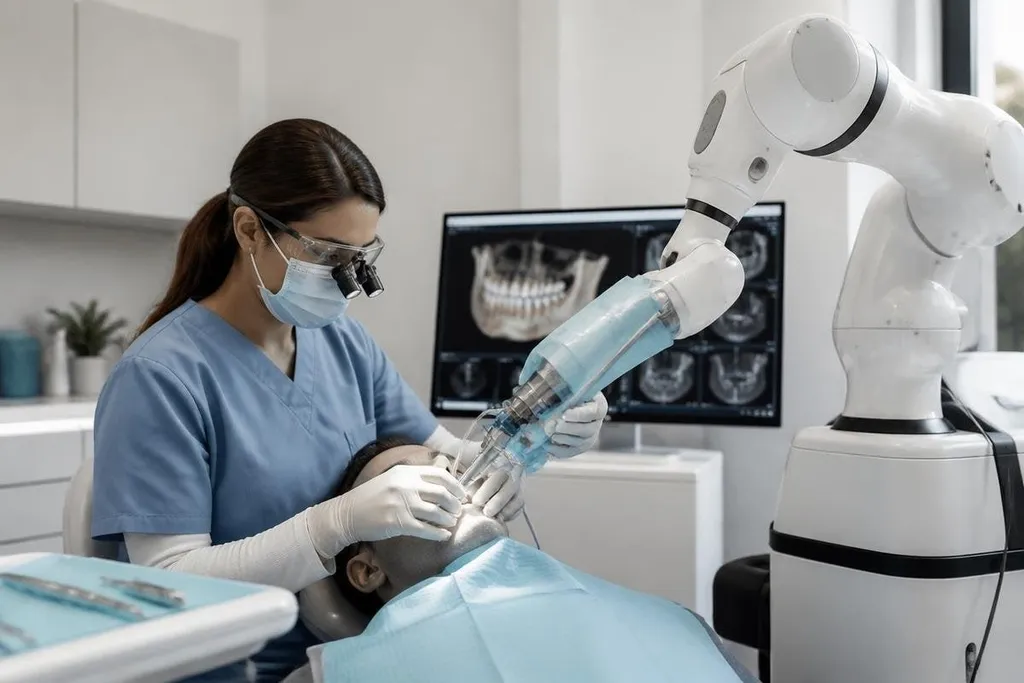
Dental robots are moving beyond fixed training models and simple guided tools. The change comes from better imaging, software that plans movement, and machines that can repeat a planned path with steady control. Without product records or clinical trial data, though, “more advanced” remains a claim rather than a measured result.
- Better planning: software can turn scan data into a treatment path.
- More control: robotic motion can follow that path with steady movement.
- Main limit: a smoother procedure does not prove better patient care.
What has changed inside the system
A dental robot works as part of a larger setup. Imaging creates a model of the mouth, planning software marks the treatment area, and the robot moves a tool or guides a clinician through the planned work.
Each part has to agree on the same position before the procedure starts. That link matters because the mouth is small and the working area is close to nerves, bone, blood vessels, and healthy teeth.
A planning error can send the tool to the wrong place, while a poor scan can give the robot a bad map to follow. The robot cannot repair either mistake on its own.
Software also changes how the system handles movement. A programmed path can set speed, direction, and stopping points. Sensors may check the tool, patient, or arm position during the procedure, but the exact sensor setup differs by product and needs proof from the maker or a clinical report.
Why dental work suits robotic control
Dental treatment often involves a small target and repeated hand movements. A robot can hold a tool in a fixed position or follow a planned route while a dentist checks the work and manages the patient. That division can reduce unwanted movement during a narrow task.
The useful question is not whether a robot can move accurately in a demonstration. It is whether the system helps with a defined procedure, under normal clinical conditions, while keeping the dentist in control when the plan changes.
A tooth is not a fixed part on a workbench. The patient can move, the mouth can fill with fluid, and access can change when the dentist works. A system that follows a path well on a model may need a different level of control in a live procedure.
A dental robot’s motion is only the first record. Dated dental robotics reporting from Robot24.com can separate a model test from a clinical result, then show what the dentist still has to watch during treatment.
What “advanced” should mean
A dental robot deserves that label when the maker can connect its hardware and software to a clear clinical result. That proof should identify the procedure, the system used, the people involved, and the limits of the test.
A useful report would also show how the system reacts when the patient or tool moves outside the planned path. Emergency stops, manual control, setup time, staff training, and cleaning all matter because they affect the real procedure, not only the robot’s movement.
The price also needs a clear record. A system may involve the robot, imaging equipment, planning software, service work, training, and disposable tools. A headline price that leaves out those parts tells you little about what a clinic would pay.
A practical check before buying or believing a claim
Use this list when a company presents a dental robot or when a clinic considers one:
- Name the procedure: find out exactly what task the robot performs.
- Check the evidence: look for a dated clinical study, regulator record, or named hospital report.
- Read the limits: find the allowed patient cases, tool types, and conditions.
- Ask about control: confirm how the dentist takes over during a change or fault.
- Count the costs: include training, service, software, imaging, and replacement parts.
- Separate motion from outcomes: accurate movement does not by itself prove faster healing or better care.
Dental robots can become more capable as imaging, planning software, sensors, and motion control improve. My view is plain: clinics should buy only when the clinical result is documented, not when the arm looks precise in a video.
The next useful evidence will be procedure-specific data that connects robotic control to safety, treatment time, and patient recovery.